The 3 Layers of the AI Transition. Intelligence Like Water?
Originally published June 9, 2026 — Gerd Leonhard
In 2005, Dave Kusek and I coined the phrase “Music Like Water” in our book The Future of Music. That vision anticipated the streaming economy that eventually gave rise to services such as Spotify. Now I’d like to introduce another idea: INTELLIGENCE LIKE WATER.
What happens when intelligence becomes abundant, inexpensive and accessible almost everywhere? This is the fundamental proposition behind the emerging AI economy.
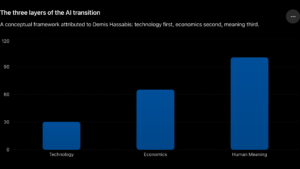
The Three Layers of the AI Transition
1. Technology
The first layer is technological: creating AI systems capable of outperforming humans across a growing range of cognitive tasks.
As intelligence becomes cheaper and more widely available, capabilities once limited to highly trained specialists could become accessible to almost everyone.
The fundamental question: Can we do it?
2. Economics
The second layer is economic. AI promises enormous productivity gains and a dramatic reduction in the cost of expertise.
But abundance does not automatically create fairness. Labor markets, ownership structures and wealth distribution will need to adapt, and our institutions are not necessarily prepared.
The fundamental question: How do we organize society around abundance?
3. Human Meaning
The third and perhaps most important layer is philosophical.
When intelligence is no longer humanity’s unique competitive advantage, traditional identities based on achievement, expertise and productivity will be challenged.
The fundamental question: What gives life meaning when survival and work are largely automated?
The Central Arguments
| The Old World | The AI World |
|---|---|
| Intelligence is scarce | Intelligence becomes abundant — like water |
| Work creates value | Direction creates value |
| Survival dominates attention | Meaning dominates attention |
| STEM drives progress | The humanities regain central importance |
The Key Insight
AI represents a potential civilizational transition: from solving the problem of survival to confronting the problem of meaning.
The technological challenge is building capable machines.
The economic challenge is distributing abundance.
The philosophical challenge is understanding who we are when our worth is no longer measured primarily by what we can produce.
The future of AI is not merely a technological question. It is a question about the future of humanity.
— Gerd Leonhard
Demis Hassabis just handed the future of civilization to the philosophers.
Not more engineers. Not more compute. Not more code.
A direct call to arms for the humanities.
Hassabis: “It’s very urgent that we really think about the second-order consequences. Many of you in the humanities subjects, it’s now your time in my opinion.”
The CEO of Google DeepMind. The man further down the road of artificial intelligence than almost anyone alive.
And he’s saying the next chapter doesn’t belong to him.
He laid out the exact sequence of what comes next.
First, get the technology right.
Then, rewrite the economics.
Then, face the philosophical questions about the human condition.
That third layer is where everything changes.
Because we’ve spent all of recorded history defining ourselves by what we can do. Think. Build. Solve. Create.
Intelligence was the currency. The differentiator. The thing that separated us from everything else on this planet.
And we’re about to make it abundant.
When the thing you built your entire identity around becomes something a machine does better, faster, and for free…
You don’t have a technology problem.
You have a mirror.
And the mirror is asking one question.
What are you without the doing?
Most people look at that question and see obsolescence.
Hassabis sees elevation.
Hassabis: “I’m very optimistic that we’re gonna get this right. I’m a big believer in human ingenuity, especially when the pressure’s on.”
This is not a warning about the end of the world.
It’s an invitation to build a better one.
For a century, society pushed the humanities to the margins. We prioritized the mechanics of survival over the philosophy of living.
That era is over.
When artificial intelligence automates the mechanics of survival, philosophy ceases to be a theoretical luxury.
It becomes the most critical applied science on Earth.
Algorithms cannot calculate what constitutes a virtuous life. Code cannot assign meaning.
The technologists are about to hand us infinite leverage. But infinite leverage without human direction is just chaos.
Hassabis: “Humanity has always figured it out when the chips are down. And they are now.”
The chips are down.
But that’s exactly where this species does its best work.
We spent ten thousand years building a machine that could lift the burden of basic survival.
We succeeded.
Now we finally get to figure out what it actually means to be alive.
— Dustin (@r0ck3t23) June 8, 2026