
Published first in 2022, and updated in July 2026.
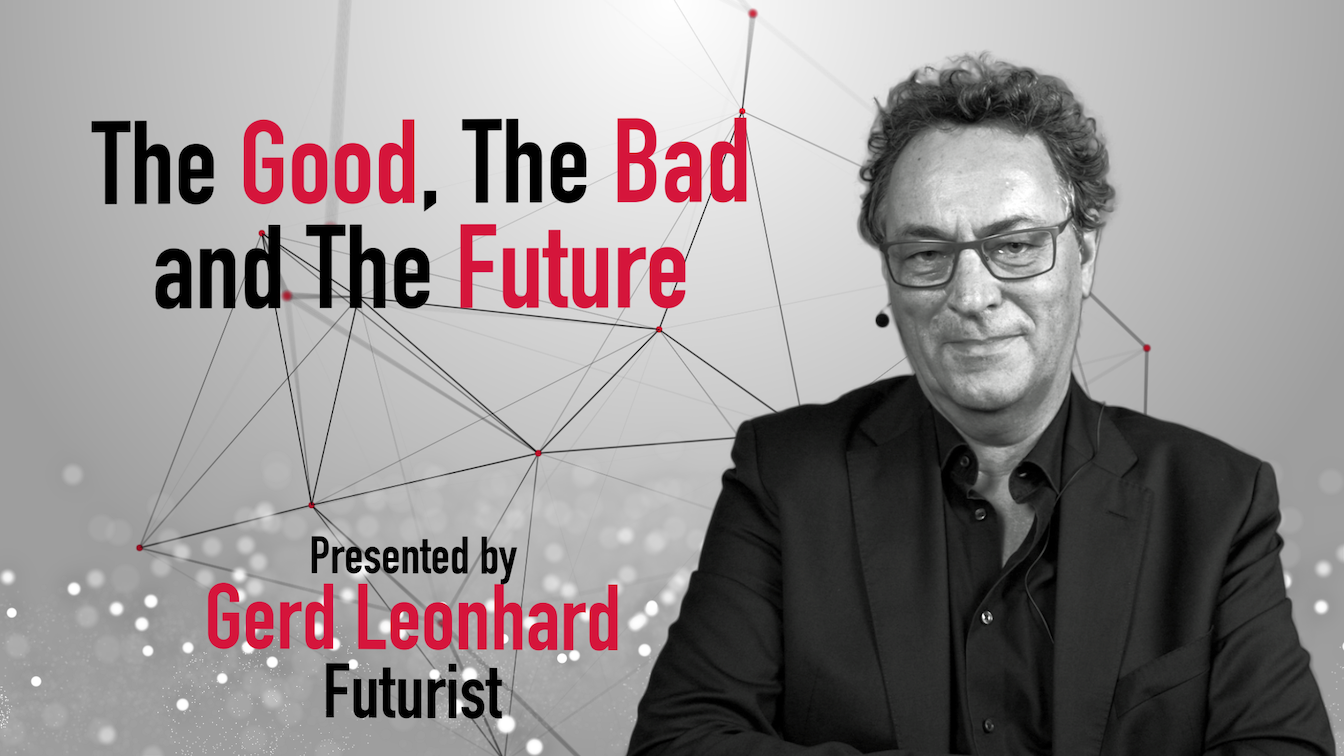
The Good, the Bad and the Future: An important message by Futurist Gerd Leonhard.
In times of crisis and hardship we must remember the Good Future.
In 2022, I produced a really important film in the midst of the Covid-19 crisis: The Good Future, set and shot in beautiful Lanzarote, Canary islands (where I now spend quite a bit of time working and writing). The film laid out why I think a Good Future is entirely possible, and what we need to do to make it happen.
Since then, The Good Future has become one of my key speaking topics, yet now that we are facing one major global crisis after the other (from geopolitics to super-intelligence) a lot of people seem to be challenged by the very concept of a Good Future. How could I possibly speak about a Good Future when we’re facing the worst possible future, at this very moment? The Bad Future?
Hence I decided to formulate a response, below, available as a long-read but illustrated blog post , as an animated video, and as an audio-recording / podcast.
So, what can an idealized view of the good future do for us today? On the face of it, not much. Just ask the average person if they feel secure about the future – in practically any country – and they will answer in the negative. The old look on the young sympathetically, relieved to have so much life safely lodged already in the past. The young envy the old, beneficiaries of a time and place when post-war prospects just kept getting better.
Yes, the future now may look more hopeless than it ever seemed, and yet that is exactly why we need it to navigate the dark night of the present. The future has always been a powerful player in human history. At times it has played the role of a religious creator, at other times it has adopted the mask of the powerful state. Humanity has always felt the need for mythology to process its mortality, and transhumanism itself can be seen as a new religion riffing off that same transcendence.
But what exactly can the future do for us in these terrible days, when innocent citizens are bombed in their own homes, in a country so very near to many of us. These shocks are not isolated, and the combination of their effects has compressed our sense of the future – and of what is possible. And yet, the future is no longer a period of time to somehow arrive tomorrow – the future is now a present state of mind. The future is, in fact, a mindset, and a way of being. Technology has propelled the human race into seeking godlike omnipotence – but we must still agree on the fundamentals of ethics and values.
The key question is no longer ‘what kind of future is possible’ but ‘what kind of future DO WE WANT’? For us, and most importantly, for our children.
In my 23+ years of working as a Futurist and Keynote Speaker, around the globe, I have learned four strange things about the future. First of all, the future is more like an emotion than it is a chronological phase. People deposit feelings there, in the future, and some people park their baggage there. Young cultures park their hopes, ageing cultures often park their nostalgia.
Secondly, you can grow your sense of the future just like you grow a muscle. I have learned that returning to the present from an imagined future is a radically effective way of solving many intractable problems. As Einstein said, you cannot solve a problem with the same state of mind that you had when you created it. You need to switch to a future state of mind.
Third, there is a tight connection between crisis and renewal, as if the decisions taken during a crisis result in future equilibrium. After the disastrous 1940s, with much of modern Europe a rubble of stones like ancient Rome, who could have imagined the decades of peaceful harmony and innovation that were to come? But the fourth thing I have learned about the future is this: only human beings are aware of it. In times of threat and danger our sense of the future shortens and many of us focus on mere survival. But the longer our runway into that future, the more alternatives we can see.
Futurists cannot save the planet, but they can help their audiences to be less surprised, and transfer a stronger feeling and intuition about the future to the public. When history returns, complete with its apocalyptic traumas and tragedies, that is when we need to reconnect with what is possible. The future is always better than the past because it hasn’t happened yet, and in that ‘not happening yet’ lies a vast potential for human betterment. So, while the transhumanists await the Singularity like a flood from the heavens to float their ark, how can we deploy the future as a problem-solving tool, today?
Terrible events do not cancel the future – they challenge us to reimagine it.
Once upon a time, the dream of a united Europe was built on the smouldering wreck of a civilisation. Today, I think we can re-dream that future without wrecking our civilization again. Voltaire’s famed Pangloss character may live in the best of all possible times, but I think we can replace that kind of naïve optimism with something better – a remembered future. And this is my final lesson learned as a futurist – you can remember the future just like you can remember the past. You can experience the next state in your imagination and return with that blueprint into the present, back from the future so to speak.
Today, we need narrative propulsion once again, a new focus on imagination and intuition, leading us into an expanding future, and into The Good Future. And the more that present challenges us with ghosts of the past, the more we need the future to balance, inspire and steer us. The old Vikings dreaded fog because it stopped them navigating by the stars. Today’s constellations are also obscured by the fog of war and the ludicrous actions of autocratic regimes. But the stars – and the future – are still there above it all.
The future is a safer harbour than both despondency or nostalgia, because there is nothing new to learn in the old spaces. The problems we face – whether extremism, war or climate change – cannot be solved with the same state of mind we had when we created them. First change your state, then tackle your problems with a new mind – the future-ready mind. Riffing off Antonio Gramsci, this future-ready mindset may well entail a pessimism of the intellect, but always an optimism of the will, and the heart.
Each one of us can be a futurist, even in these taxing times. Indeed, especially in trying times. The futurist is not an escapist or an apologist or a mind-warper or a fortune-teller but a navigator and explainer of the possible. As we narrow down our focus into hourly news reports, we must remember to also expand our vision into both near and distant horizons, as the speed of history often resembles a ‘permacrisis’ in today’s world. Don’t project forward into the future, start with the future and work your way back from there.
The future belongs to those that have been there in their minds.
‘The Good, The Bad and The Future’ – watch the video or download it here.




