Europe2031.ai “what getting AI wrong means for us” was widely lauded as one of the best scenario exercises published on AI geopolitics in recent years. It is not meant to be a prediction, though, I would say. It is more like a deliberately pessimistic (and sometimes outright doomy) scenario designed to shock and hopefully catalyze European policymakers by extrapolating current trends ; it’s a fictional scenario grounded in present-day developments rather than a forecast.
Here is what my combined AI helpers have compiled, after much prompting-torture, about how likely this scenario is (plus my added comments, of course)
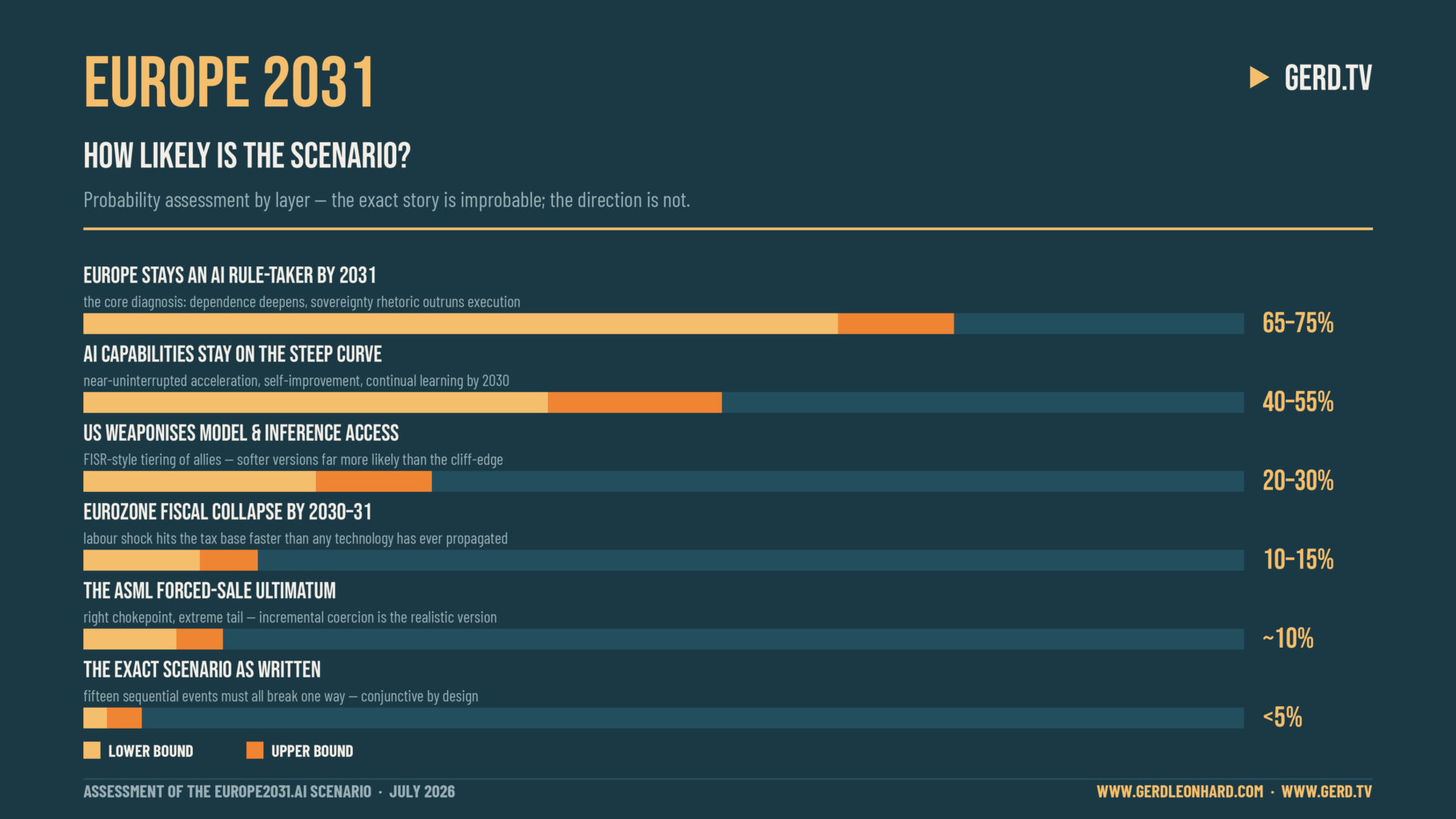
The exact scenario: <5% Any narrative this specific is conjunctive. It requires ~15 sequential events to break one particular way (FISR-style inference rationing, the ASML ultimatum, a euro crisis by 2030, the Washington showdown). Multiply even generous per-step probabilities and you land in the low single digits. The authors know this; it’s a warning device, not a forecast.
The core thesis — Europe fails to close the gap and dependence deepens: ~65–75% This is the strongest part. The compute asymmetry is real and widening, European capital markets can’t fund frontier-scale rounds, the sovereignty rhetoric-to-execution gap is exactly as described, and the “announcements repackaging old money” pattern is well documented. Absent a genuinely wartime-style mobilisation — which nothing in the current political economy suggests — Europe being a rule-taker in AI by 2031 is more likely than not. Gerd adds: I have presented versions of this myself for years – I think this is the most likely scenario, as troubling as that may sound.
AI capabilities continuing on the scenario’s steep curve: ~40–55% The scenario assumes near-uninterrupted acceleration, recursive self-improvement kicking in, continual learning solved by 2030. Plausible, but this is the biggest single uncertainty. If progress plateaus or diffuses more slowly into GDP, the whole economic-collapse mechanism weakens dramatically. Europe muddles through in that world — poorer relative to the US, but not disintegrating. Gerd adds: I think this is less than 40% likely – more like 25%.
The US weaponising model/inference access against allies: ~20–30% Directionally credible given export-control precedent and the current transatlantic climate, but the FISR construct assumes Washington accepts enormous commercial and diplomatic costs, and that US labs quietly comply. More likely: softer versions — priority tiers, informal delays — that hurt Europe without the cliff-edge drama. Gerd adds: imho, after Trump gets kicked out (let’s be optimistic… later this year…?), and his cabinet withers as well (stay tuned for that forecast), we may see a new detente between the U.S. and Europe (yes that’s me being hopeful) – so I would give this 10%, but starting around 2028.
Below are the wildcards — I agree that these are very unlikely.
Eurozone fiscal/political collapse by 2030–31: ~10–15% This is where the timeline gets too compressed. Labour displacement at the scale needed to break French public finances within four years outpaces even bullish adoption curves. The fiscal fragility is real (France’s debt service trajectory is genuinely alarming), but the scenario needs AI to hit the tax base faster than any technology has ever propagated through an economy.
The ASML endgame: ~10% It correctly identifies ASML as Europe’s only true chokepoint — that insight is the most valuable thing in the piece. But a forced joint-holding ultimatum is an extreme tail. The realistic version is what already happened with DUV export pressure: incremental coercion, Dutch acquiescence, no cinematic showdown.
Bottom line: treat it as ~5% as literal prediction, ~70% as directional diagnosis, and close to 100% correct in its central accusation
Which is: Europe’s response is calibrated to a world where AI is one industry among many, not a general-purpose civilisational reset. The epilogue’s prescriptions (special compute zones, middle-power coalition, flexicurity, a positive vision rather than a defensive one) are the part worth amplifying. That last point – Europe having only a negative vision – is squarely in my own territory, and arguably the scenario’s deepest insight.
The Economist: How Europe must respond to America’s AI warning shot (Judith Dada)
My summarized forecast
If I had to make a calibrated forecast today:
- Europe remains politically unified: 95%
- Europe falls further behind the US in frontier AI: 90%
- Europe loses technological sovereignty in some critical AI infrastructure: 50%
- Europe suffers prolonged economic stagnation because of AI: 40%
- Europe experiences a genuine geopolitical AI crisis: 72%
- Europe becomes strategically irrelevant: 10%
Europe has genuine structural and economic risks in AI, but its distinctive strengths in human-centered governance, industrial capabilities, and social resilience could lead to a different path than the scenario’s most pessimistic outcome. IF Europeans can find the courage to act. IF we can prioritize daring innovation over safety. IF we can make the future a real priority. IF we can unite behind a true pan-European agenda. IF we can leave our comfort zones. IF we can stop acting based on fear.