Here are 2 videos on this topic, as well as 3 images riffing off this recent pierce by The Atlantic: Three Ways to Think About AI and Jobs: Whether automation will make human workers obsolete depends on more than just how smart the AI is.By Rogé Karma. This is a 5* read!
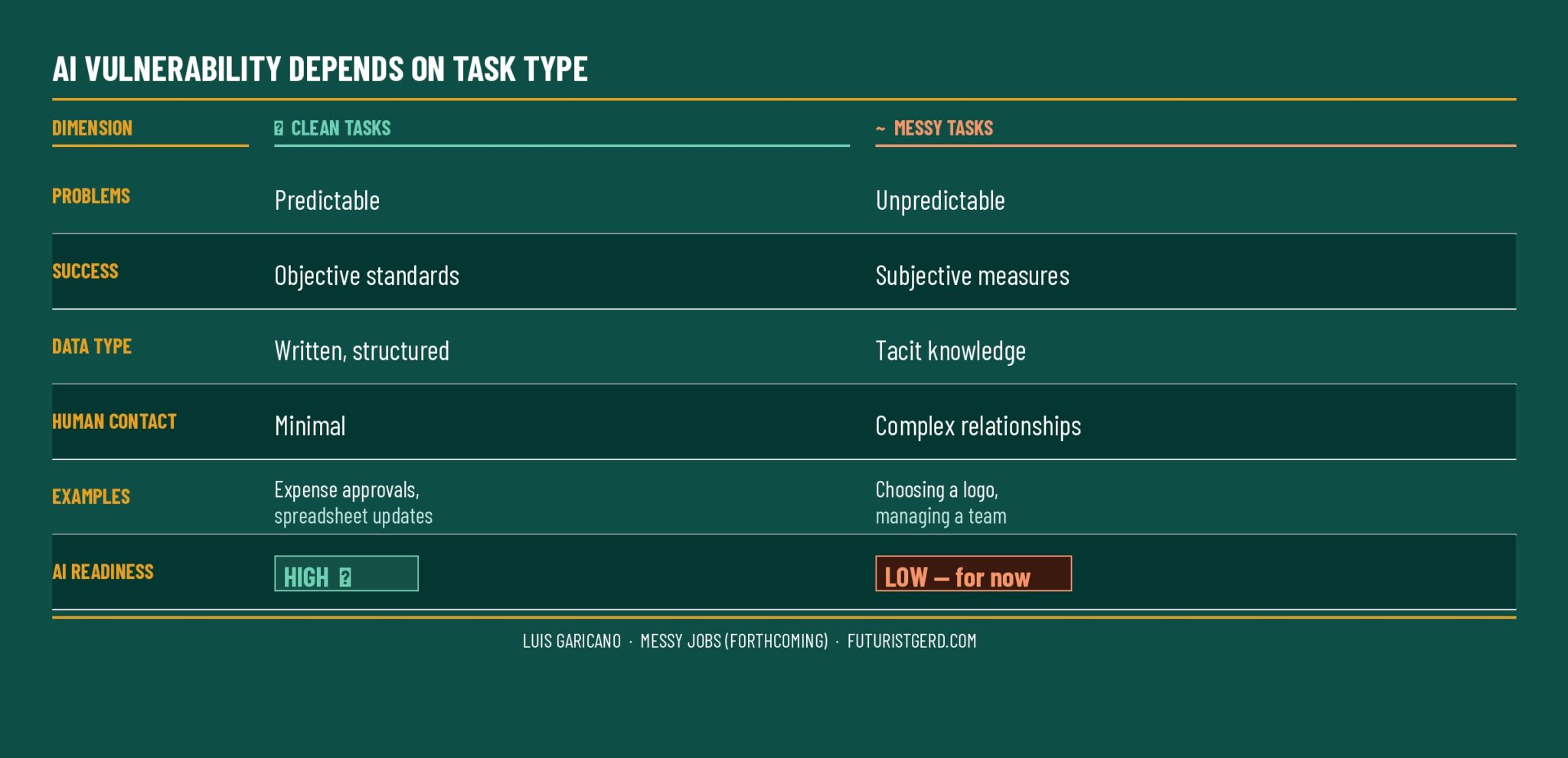
“According to Luis Garicano, an economist and a co-author of the forthcoming book Messy Jobs, most white-collar jobs combine two very different kinds of work. “Clean” tasks involve predictable problems, objective standards of success, lots of written data, and little interpersonal interaction (think: approving an expense report or updating a spreadsheet). These are the easiest for AI systems to handle.
“Messy” tasks, however, involve dealing with unpredictable situations, meeting subjective measures of success, acting on tacit knowledge, and navigating complex webs of human relationships (think: choosing a new corporate logo, assuaging an upset client, or managing a team). AI isn’t so good at these kinds of tasks, at least not yet. This means that a job’s susceptibility to AI replacement depends, in part, on how easily the clean tasks can be cleaved off from the messy ones.
According to the MIT economists David Autor and Neil Thompson, the divergence between these two professions (weak bundles or strong bundles) boils down to the interaction of technology and expertise. For accounting clerks, computers replaced many of their least expert skills; the hours they had spent recording transactions and performing manual calculations could now be reallocated to more complex tasks, such as explaining why a department had blown through its budget and figuring out sources of discrepancies between a company’s bank account and its books. This turned the accounting clerk’s job from a middle-class one into a smaller, more professionalized one.
For inventory clerks, on the other hand, computers replaced their most expert skill set—their encyclopedic knowledge of a warehouse’s physical inventory—leaving them to perform more basic tasks such as scanning items and restocking shelves. This transformed the inventory clerk’s role from a well-paying middle-class profession into a lower-paid job with a far bigger pool of potential workers.
In a recent paper, Autor and Thompson find that this basic pattern has held up across more than 300 occupations over the past four decades. “The story is almost never as simple as: We’re in a race with machines and machines will win”
“What matters for a given profession is whether technology enhances a worker’s expertise or commodifies that expertise.”